Reference: Connection Settings and Details
10/06/2026
The Connection Settings and Details page includes two tabs: Connected libraries and lists and Connected sites.
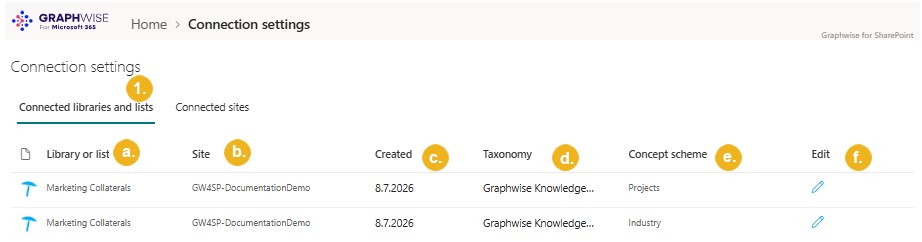
This tab lists all connected SharePoint libraries, lists, and their associated Graph Modeling taxonomies and concept schemes.
 |
Note
You can connect a library or list to multiple Graph Modeling taxonomies and concept schemes. You can also connect the same taxonomy multiple times to the same library or list, each with unique settings. Each connection is listed as a separate entry.
Tip
You can sort the list by clicking a column header.
All connected libraries and lists has the following columns:
Library or List (a) - name of the library or list; click the name to open it
Site (b) – name of the site containing the library or list; click the name to go to the site
Created (c) – date the library or list was connected to a Graph Modeling taxonomy
Taxonomy (d) – name of the connected Graph Modeling taxonomy (project)
Concept schemes (e) – connected concept schemes, if tagging based on concept schemes was enabled
Select the pencil icon under the Edit (f) column of the Connection settings dialog box. For more information on how to edit the individual settings, refer to Editing Tagging Parameters.
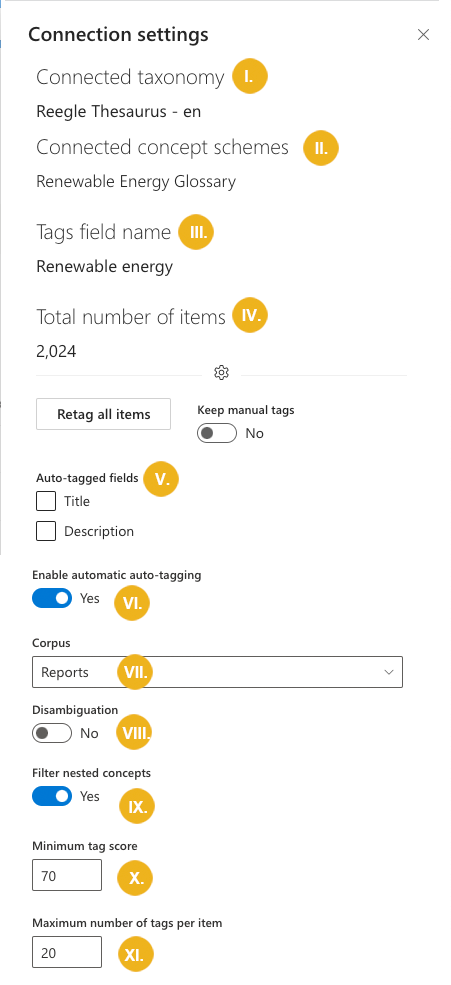
Connected taxonomy (I) – name and language code of the connected Graph Modeling taxonomy (project)
Connected concept schemes (II) – If tagging based on concept schemes is enabled, this field contains the names of the connected concept schemes
Tags field name (III) – name of the field that stores tags in the document library or list
Total number of items (IV) – number of the documents in the library or items in the list
Auto-tagged fields (V) – fields in the library or list that are auto-tagged
Note
The body of the documents in document libraries will always be auto-tagged.
Enable automatic auto-tagging (VI) – if selected, Graphwise for SharePoint automatically auto-tags items you add to the library or list at a later time
Corpus (VII) – if a corpus is selected, the relevance scores of extracted terms in this corpus are considered. This is useful for short documents, where term frequencies are low and document-level scoring may be insufficient
Disambiguation (VIII) – if selected, the system uses the thesaurus and local context to resolve potential ambiguities
Filter nested concepts (IX) – if selected, nested concepts are excluded from extraction. A nested concept occurs within another concept in a text
Minimum tag score (X) – higher scores result in fewer, more relevant tags. The default setting is 70
Maximum number of tags per document (XI) – maximum number of tags shown per item in a dedicated column. The default setting is 20
This tab lists the sites that contain a library or list connected to a Graph Modeling taxonomy.
Tip
Sort the list by clicking a column header.
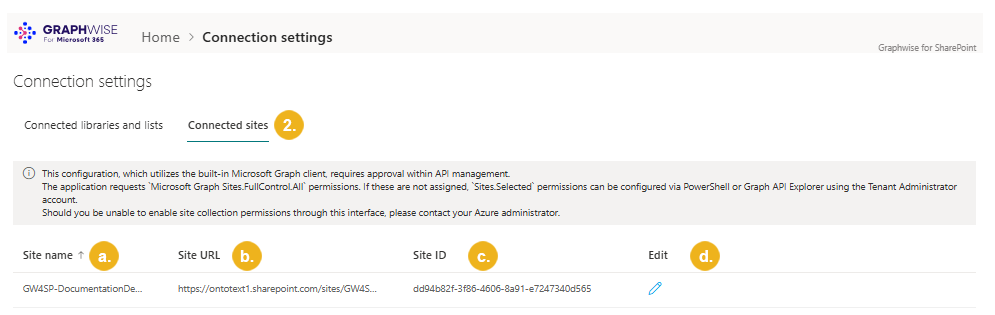 |
This tab has the following columns:
Site name (a) – name of the site containing a library or list
Site URL (b) – URL of the site containing a library or list
Site ID (c) – ID of the site containing the library or list
Edit (d) - select the pencil icon in the site's row to open the Site collection permissions pane, which indicates whether Graphwise for SharePoint can write to this site (write permissions)
Site collection permissions (d) – indicates whether Graphwise for SharePoint has write permissions for the site. To access this section, click the pencil icon in the Edit column. For details on accessing this section and how to grant or revoke permissions, refer to Configure Site Permissions