SKOS, In Scheme and Graph Modeling
SKOS, In Scheme and Graph Modeling
This section contains more detailed information on the In Scheme relations in SKOS and their implementation in Graph Modeling.
In Graph Modeling we assume a concept is part of a concept scheme implicitly, if it is hierarchically placed beneath it somewhere. The SKOS standard allows to define the relations of concepts and concept schemes to each other explicitly using skos:inScheme.
Since the skos:inScheme relation is not defined as mandatory, both approaches can be considered valid. Defining the In Scheme relations explicitly provides modelling options that go beyond the interpretation done by default in Graph Modeling.
A concept can be hierarchically related to the concept scheme without being part of the concept scheme (no skos:inScheme relation in place). At the same time a concept can be part of a concept scheme without being hierarchically related to it.
This example shows what such an explicit definition looks like in triples (from the SKOS reference of the W3C):
<MyScheme> rdf:type skos:ConceptScheme ;
  skos:hasTopConcept <MyConcept> .
<MyConcept> skos:topConceptOf <MyScheme> .
<AnotherConcept> skos:inScheme <MyScheme> .
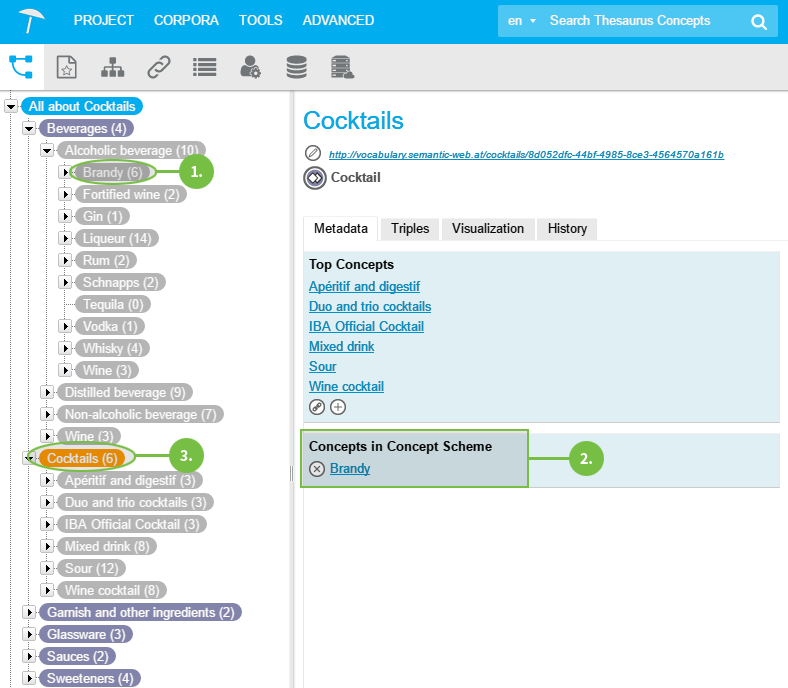
The In Scheme function in Graph Modeling and the display in its Hierarchy Tree make it easy to set up and display clearly what you have defined. The image below shows an example.
'Brandy' is originally just part of the concept scheme 'Alcoholic beverage' (1). Using the In Scheme relation function in Graph Modeling (2), it is also part of the concept scheme 'Cocktails' (3).
 |